Lottery and Prize Scams: Why the Fee Is the Warning
There is one rule that settles almost every prize message, and it does not require knowing anything about the sender: a real prize never costs money to collect. If someone says you won, and then asks for a fee, a tax, a shipping charge, or a bank account number before the money arrives, the prize does not exist. This guide explains the fee version, the fake check version, the mailed prize letter, and what to do if you already paid.
A real prize never costs money to collect
If you have to pay to get a prize, it is a scam. The Federal Trade Commission lists that as the first of three signs of a prize scam in its guide to fake prize, sweepstakes, and lottery scams, alongside two others: being asked to pay to improve your odds, and being asked for financial or personal information to claim a prize.
That rule holds regardless of the label on the payment. Taxes, customs duties, shipping and handling, processing, insurance, a lawyer’s retainer, a courier charge: the FTC names these directly as the words used to dress up the fee. The label changes, the mechanism does not.
It also holds regardless of who the sender claims to be. A government agency, a well-known sweepstakes company, a foreign lottery board, a bank holding the winnings: an impersonated name is still an impersonated name. The company or agency being named is not the one writing to you.
The second rule is nearly as useful: you cannot win a drawing you never entered. Before working out whether the message is real, it is worth asking whether there was ever an entry at all.
How the fee gets disguised
The fee is the whole product. Everything before it exists to make the payment feel like a formality rather than a purchase, which is why the amount is usually small compared to the prize on offer.
- Taxes on the winnings. The most persuasive version, because prize money can genuinely be taxable. What is false is the idea that the tax gets paid to the person announcing the prize.
- Customs, delivery, or insurance. Used when the prize is an object rather than cash, because a physical item makes shipping charges sound normal.
- A processing or administrative fee. Deliberately vague, and often described as refundable out of the winnings.
- A bank account for the deposit. No fee at all on the surface. The account details are the payload, and sometimes the account is later used to move someone else’s money, which is how people end up inside money mule schemes without meaning to.
- Repeated fees. After the first payment clears, a second obstacle appears, then a third. The sunk cost is part of the design.
Pressure travels with the fee. The FTC notes that prize scammers push people to act now, on a limited-time claim, precisely so there is no gap for a second opinion. A real sweepstakes has no reason to need an answer within the hour.
The distinction that decides it
Prize money can be taxable income. The IRS explains how prizes and awards are treated in Publication 525, Taxable and Nontaxable Income. But that tax is settled with the IRS through your tax return or through withholding by the payer. It is never collected in advance by the person telling you that you won, and never in gift cards, wire transfers, or cryptocurrency.
The version that starts with a check in your hand
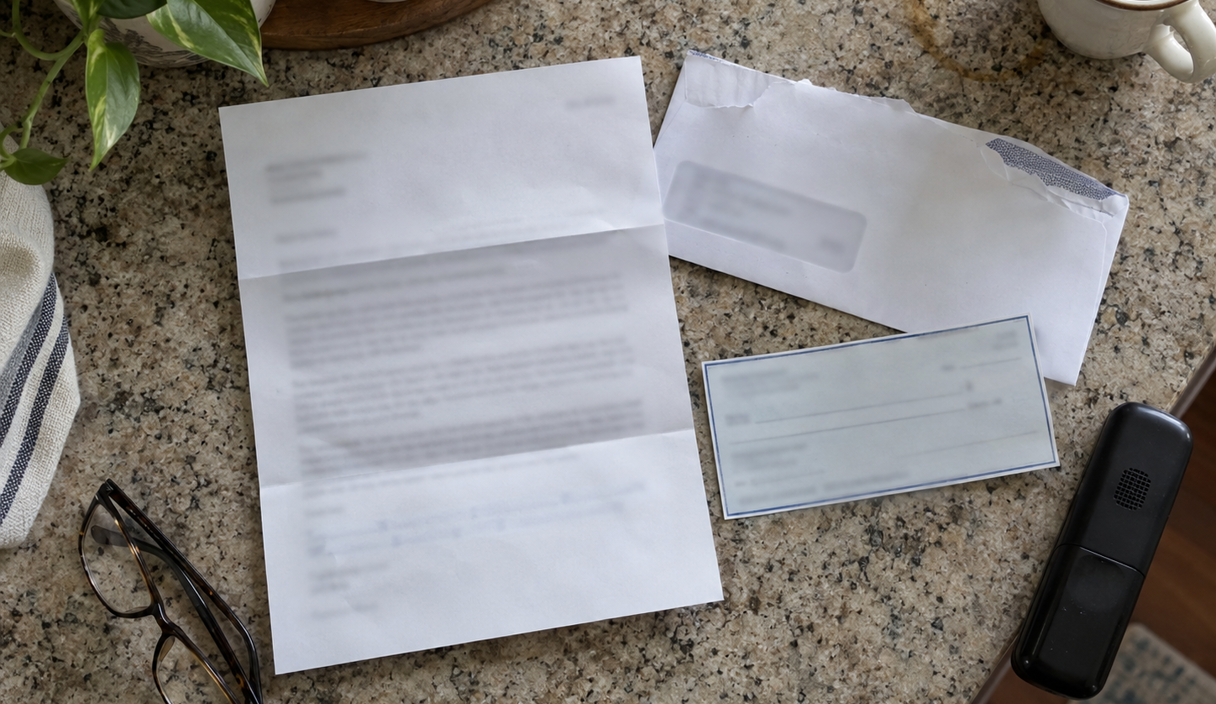
In this version nobody asks you for money up front. A check arrives, you are told to deposit it and send back part of the amount to cover fees or taxes, and the bank appears to accept it. Weeks later the check is identified as fake, the deposit is reversed, and the money you sent is gone.
The mechanism turns on a detail that sounds like a technicality and is not. A bank making funds available is not the same as a check clearing. The FTC explains in its guidance on fake check scams that it can take weeks for a bank to discover that a check is fake, and that the funds shown in the account in the meantime can look entirely real.
So the practical defense is narrow and reliable: never send money back out of a deposit that arrived from someone you do not know, and ask the bank directly whether the check has actually cleared rather than whether the funds are available. Our guide to fake check scams and check fraud goes through the timing in more detail.
Official sweepstakes mailings are held to rules on this point. The FTC says a sweepstakes mailing that includes a fake check has to state clearly that it is non-negotiable and has no cash value, and that a mailing cannot claim you are a winner unless you actually won.
The prize letter that arrives by mail
Mail carries weight that a text message does not, which is exactly why prize scams still use it. A printed notice, an official-looking seal, and a claim number feel like a record rather than a pitch.
Two checks cost nothing. Look at the postmark and the postage class: the FTC points out that a notice mailed at bulk rate went to a great many other people, which contradicts any claim that you were specially selected. Then look at what the letter asks for. A phone number to call, a fee to send, or a form requesting a Social Security number are all the same request in different clothing.
Fraud that travels through the mail is investigated by the U.S. Postal Inspection Service, which lists sweepstakes and lottery fraud among the mail fraud schemes it takes reports on. Reports go through the USPIS reporting page, under mail fraud. Do not send the letter back, and do not call the number printed on it.
Foreign lotteries and cross-border prize offers
Messages about a foreign lottery deserve a shorter conversation than most. The FTC states that it is illegal for U.S. citizens to play a foreign lottery, so an offer to sell you a ticket or to help you claim foreign winnings is asking you to break the law before anything else happens.
There is a second cost beyond the money. The FTC notes that responding marks you as reachable, and that people who engage with one fake lottery tend to receive many more offers afterward. Contact lists of people who responded are traded, which is the same reason a first loss is so often followed by a second approach.
Nothing about a cross-border story changes the basic rule. A prize that requires a payment to be released is not a prize, whether the sender claims to be in another country or down the road.
What real sweepstakes and contests look like
Legitimate sweepstakes exist, and they follow rules you can check. The FTC sets them out: real sweepstakes are free and won by chance, and it is illegal to require a payment or a purchase to enter or to improve your odds.
- If a promoter calls you, the law requires them to say that entering is free, what the prizes are and their value, the odds of winning, and how a prize is redeemed.
- Sweepstakes mailings have to state that no payment is needed to participate.
- Entering a contest often means your information is shared with advertisers, so expect more marketing mail, email, and calls afterward.
- Skill contests are a separate category. The FTC notes that a contest based on solving problems or answering questions can legally charge to play, and that rounds can get progressively harder and more expensive, which is worth knowing before starting one.
If you are unsure about a specific promotion, look up the company yourself rather than using the contact details in the message, and search its name together with words like complaint, review, or scam. The contact information supplied by whoever approached you is the one thing you cannot verify with it.
What to do if you already paid
Act on the payment method first, because that is where the only real chance of getting money back lives, and the chance shrinks by the hour. Then report, and then protect the information you may have handed over.
- Call the company that moved the money. Bank or credit union for a transfer, the card issuer for a card payment, the payment app for an app transfer, the wire company for a wire, the gift card issuer for a card. Say a scammer tricked you and ask them to reverse it. The FTC lists the route for each method in what to do if you were scammed.
- Tell the bank if you shared account details. Ask about new account numbers, alerts on the existing account, and anything already pending.
- Stop responding. Do not send a final payment to close the matter, and do not explain that you now know. Keep the messages as evidence.
- Report to the FTC. File at ReportFraud.ftc.gov.
- Report where the scam traveled. By mail, the U.S. Postal Inspection Service. Online, by email, or by text, the FBI Internet Crime Complaint Center. Add your state attorney general.
- Protect your identity if you gave out numbers. If a Social Security number was involved, start at IdentityTheft.gov, the FTC’s free recovery process.
- Expect a second approach. Anyone who calls afterward offering to recover the money for a fee is running a new scam, which the FTC describes as refund and recovery scams.
Recovery is possible in some cases and not in others, and it depends heavily on the payment method and the speed of the call. Our hub on how to report a scam and try to recover your money explains what each agency does with a report, which is worth knowing even when the money does not come back. Reports are how patterns get spotted, and they are useful whether or not your own case ends well.
When the person receiving the letters is a relative
Prize mail tends to keep arriving, and once someone has responded, the volume usually grows. That is a list problem, not a character problem, and it is worth saying out loud to the person involved, because embarrassment is the main reason these letters stay hidden.
What helps in practice: offering to open the mail together rather than taking it away, agreeing on one rule that is easy to hold to, which is that no prize gets a payment, and writing the phone numbers for the bank and the postal inspectors somewhere visible. If an older relative is being pressured repeatedly, our guide to elder financial abuse covers who to call and what a bank can do.
Advance-fee prize offers are one member of a larger family, and reading the pattern once makes the others easier to spot. Our guide to advance-fee scams covers loans, grants, inheritances, and recovery offers that use the same structure.
Lottery and prize scam FAQ
Do you have to pay taxes to collect a lottery prize?
Not to the person announcing it. Prize money can be taxable income, and the IRS explains how prizes and awards are treated in Publication 525, but that tax is settled through your tax return or withheld by the payer. A request to send tax money in advance, especially by gift card, wire, or cryptocurrency, is a scam.
How can I tell if a sweepstakes win is real?
Start with two questions: did you enter, and are you being asked for money or account details? The FTC states that real sweepstakes are free and won by chance, and that any required payment to claim a prize or improve your odds is illegal. Then look up the company yourself instead of using the contact details in the message.
The check cleared, so is it safe to send the fee?
No. Funds being made available is not the same as a check clearing. The FTC explains that a bank can take weeks to identify a fake check, and that the deposit is reversed when it does. Ask your bank directly whether the check has cleared, and do not send money out of a deposit from someone you do not know.
Where do I report a lottery or prize scam?
Report to the FTC at ReportFraud.ftc.gov. If the offer arrived by mail, also report to the U.S. Postal Inspection Service. If it arrived online, by email, or by text, add the FBI Internet Crime Complaint Center at IC3.gov, and file with your state attorney general.
Can I play a foreign lottery from the United States?
The FTC states that it is illegal for U.S. citizens to play a foreign lottery, so any offer to sell tickets or claim foreign winnings should be treated as a scam. Responding also tends to bring more offers, because lists of people who reply get traded.
Someone says they can get my prize released for a fee. Is that possible?
Treat it as a second scam. The FTC describes refund and recovery scams as schemes that specifically target people who already lost money, often using details bought from a list. No legitimate agency charges a fee to release a prize or recover a loss.
Keep reading

Advance-Fee Scams: Why Paying First Is the Trap
Loans, grants, prizes, and recovery offers share one shape: money up front for something that never arrives.
6 min readRead

How to Report a Scam and Try to Recover Your Money
Where to report, in what order, what each agency does with the report, and what recovery realistically looks like.
7 min readRead

Impostor Scams: Government, Business, and Family Impersonation Explained
One mechanism behind many scams: someone you trust, a problem invented, and a payment that cannot be undone.
7 min readRead