How to Verify a Company Is Legitimate Before You Pay
To verify a company is legitimate, check three places: your state’s business search (run by the secretary of state), the company’s Better Business Bureau profile and complaints filed with your state attorney general. A registration proves a filing exists, not that the company is honest.

A good review, or a purchase that went fine for someone else, tells you something about a company’s history and leaves the important questions open. A name can be copied, a registration can belong to a different business, and the payment method can send your money to someone else entirely.
So use the same measure for every business, without starting from the conclusion. Identify who is selling, look up the public registration, find the history outside the company’s own channels, read the offer, check who receives the money, and confirm the contact through a route you found yourself.
This works for an online store, a profile selling through direct messages, a contractor, and an app you saw in an ad. The aim is to find what does not line up before you pay, not to reach a verdict about the company. If the offer involves investing, lending, or earning money through an app, there is one more check, covered in how to tell if something is a scam: whether the firm and the person are registered with the Securities and Exchange Commission or with FINRA.
What to check in one minute
If the payment is about to go out, do only this:
- Find the company’s full legal name, not just the brand in the ad.
- Look that name up in the business registry of the state where the company says it is based, and compare what is registered with what is being sold to you.
- Read the name of the recipient on your bank’s confirmation screen, before you approve anything.
- Search the name outside the company’s own channels.
If something does not line up, stop the payment and ask for an explanation through the official channel. A seller in a hurry is not a reason to pay without those answers.
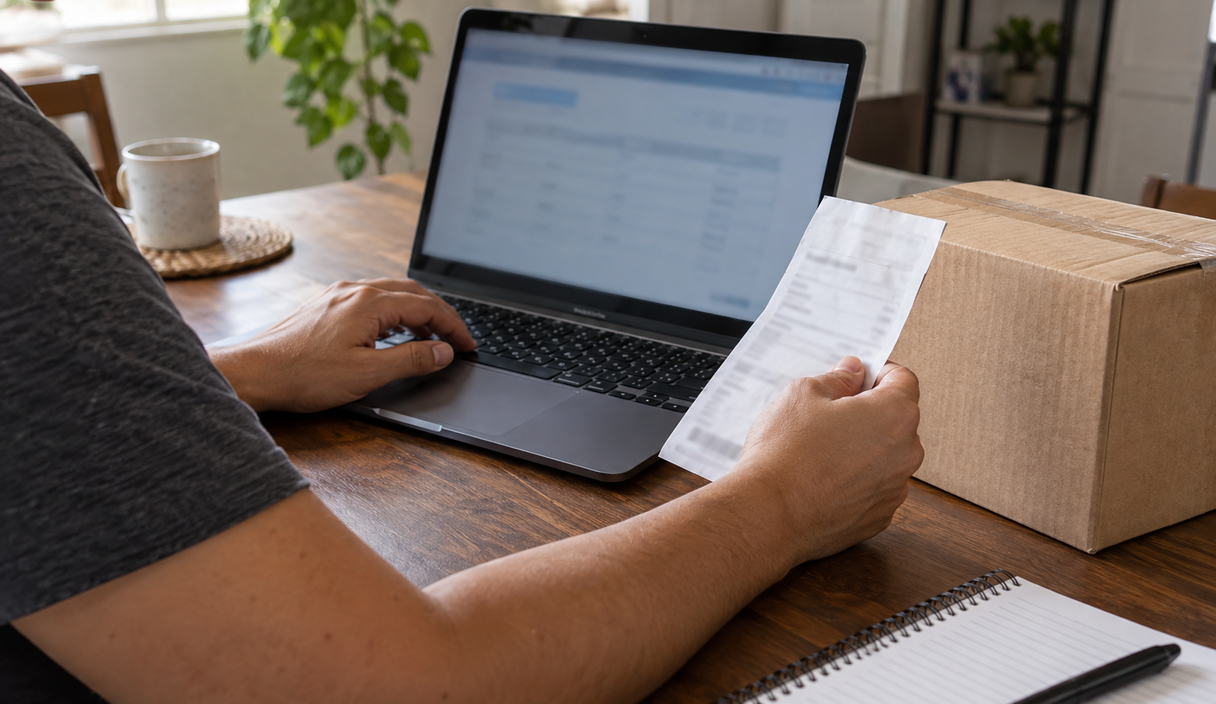
1. Find the full legal name
Sometimes the only thing on offer is the brand in an ad, on a profile, or on a label. That is not enough to know who is selling. Look for the full legal name and the details that go with it.
The legal name usually sits in one of three places:
- In the footer of the site, next to the street address and the phone number.
- In the terms of service or the privacy policy, where the entity responsible for the service is normally named.
- In the bio of a business profile, when the sale happens on social media.
If you looked in those places and found nothing, the basic information about who is selling is still missing. Ask for it before paying. When the sale happens on a website, it is also worth reading the address with the care described in how to spot a fake website.
2. Look the business up in the state registry
Every state keeps a public register of the businesses formed or registered there, normally run by the secretary of state, and most of them let you search it for free by company name. That search is the closest thing there is to a single official record of a business, and it takes about a minute.
Compare four things with the offer in front of you:
- The legal name: see whether it has any relationship to the brand selling to you. A company operating under a different trade name usually has to register that name too, and that filing is public.
- The status: a filing that is dissolved, delinquent, or administratively closed is worth asking about before you continue.
- The registered agent and address: compare them with the contact details on the site. An address that turns out to be a mailbox service is a question, not a conclusion.
- The formation date: a business registered a few weeks ago simply has less history to look at, which changes how much weight the other checks carry.
Some businesses need more than a registration. Contractors, electricians, plumbers, insurance agents, and many other trades are licensed by a state board, and those licenses are searchable too. For a charity asking for a donation, the IRS tax-exempt organization search shows whether the organization is recognized and whether donations to it are deductible. For anyone selling an investment, the SEC’s investment adviser search and FINRA’s public records show registration and disciplinary history.
When the legal name or the registered activity does not match the brand and the product, there can be a legitimate explanation, such as a company that runs several brands. Ask for the full identification and confirm the connection through an official channel before paying.
What a registration does not prove
A business registration proves that a filing exists. It does not prove honesty, and it does not prove that the person contacting you belongs to the company on the filing. Compare the legal name, the activity, the address, the people named, the contact channel, and the recipient of the payment. The registry is one part of the picture, not a certificate about the offer.
3. Find the official channel yourself
Everything up to this point reached you through a route somebody else chose: a link, an ad, a message, a phone number. The check has to happen outside that route.
In practice: close the conversation, search for the company by name, go in through the address or the app you found yourself, and ask there whether that charge exists. If the company does not recognize it, or gives you different details, do not pay, and save a record of what you were told.
One note about phone numbers. A number that appears inside the message you are checking cannot be used to check that message. The number that works is the one on the official site, inside your banking app, or on the back of your card. For what a phone number can and cannot tell you, see who owns this phone number.
4. See who receives the money
This check happens on the confirmation screen, inside your own banking or payment app.
Before you approve a transfer, the app shows the name of the person or business receiving it. Stop on that screen and compare it with the company selling to you. Three situations deserve a pause:
- The money is going to an individual, when the seller presents itself as a company.
- The name has no relationship to the brand or to the legal name you looked up.
- The account changes between one conversation and the next, or arrives with an explanation about the main account having a problem.
A small business can legitimately receive payment in the owner’s name. Ask why the recipient is different and see whether that name appears on the business filing. If nobody can connect the recipient to the company, do not send the payment.
An example
A profile selling discounted phones lists a company name in its bio. The state registry does have an active filing under that name, except it belongs to a sandwich shop in another county. At the payment screen, the app shows the name of an individual who is not listed on the filing. Each detail on its own could have an explanation. Together, they show that nobody has connected the store to the filing or to the recipient, and that is enough not to pay.
5. Look the company up outside what it publishes
The site and the profile are sources controlled by the company, including when they display reviews. Look at sources it does not control and compare what you find.
- Search the brand name, the legal name, and the owner’s name together with the word complaint or scam.
- Look for a profile at the Better Business Bureau, a private organization where consumers file complaints and companies can respond. Read the recent complaints and see whether the same problem keeps coming back.
- Check the consumer alerts published by your state consumer protection office and by your state attorney general, which is where enforcement actions against local businesses are announced.
- Read reviews on platforms the company does not own, and treat a cluster of five-star reviews posted in the same week as a question rather than an answer.
- Many state courts publish a public case search. Availability, cost, and how far back the records go vary a lot by state, so treat what you find as context.
Use all of it as context. A large company almost always has complaints and lawsuits somewhere, and a lawsuit does not mean the company lost it. What helps is whether the same problem repeats, such as orders that never arrive, and how the company answers. Finding nothing can simply mean the business is new or files under a different name.
When there is no trace at all
Sometimes the search turns up no legal name, no registration, and no history that identifies who is selling. That blocks the most basic check there is, and that check is the one protecting your money.
Without a confirmed identity, do not use a small purchase as a test. Before paying anything:
- Ask for the legal name and the state where the business is registered. Look the details up and compare them with the brand, the product, and the contact.
- Confirm how the pieces connect. If the brand, the legal name, the activity, or the recipient differ, ask for an explanation and verify it through an official channel.
- Do not pay while the identity is unclear. If the details stay missing or cannot be confirmed, do not complete the purchase.
Payment method and what can be disputed
The payment method changes what routes exist if something goes wrong. None of them makes a purchase automatically safe, and none guarantees you get the money back.
A credit card gives you the most room, because the issuer has a dispute process and federal rules behind it. A debit card gives you less, and how much less depends on how fast you report. An instant transfer through a payment app, a wire, a gift card, or cryptocurrency works like cash, which is exactly why scammers ask for them. The FTC’s guidance on what to do if you were scammed is organized around that difference, and our guide to chargeback versus refund explains what a dispute actually is.
Honest businesses do offer discounts for paying in ways that cost them less in fees. What is worth stopping for is pressure: a discount that only holds if you abandon the card, a charge sent by message, an account in a person’s name, or a payment made outside the place where the purchase started.
If you already paid
The fault lies with whoever set the situation up, not with the person who believed it. What to do next depends on which of the two problems you have: a scam, where the store or the profile was never real, or a dispute with a company that exists and did not deliver.
If it was a scam
This covers a store that vanished, a fake profile, or a product that was never shipped.
- In the first hour, call your card issuer or bank using the number on the back of your card. Say the word fraud. If you paid by credit card, ask to dispute the charge; the FTC explains the steps in disputing credit card charges, and our guide to how to dispute a credit card charge covers the written notice and the deadline.
- If you sent an instant payment or a wire, tell the bank immediately. Those are hard to reverse and the chance depends on speed. The steps are in what to do after an instant payment scam.
- Keep everything. The receipt, the messages, the ad, the profile, the address, and the name that appeared on the confirmation screen.
- Report it. File at ReportFraud.ftc.gov and, if you lost money, at the FBI’s Internet Crime Complaint Center. A police report is worth filing too, since banks and insurers often ask for one. The order to do this in is in how to report a scam.
If the company exists and did not deliver
Late delivery, the wrong item, a defect, or a refused return are consumer problems, not fraud, and they follow a different path. A fraud dispute is not the right label for a seller who made a mistake.
- Contact the company in writing and keep the case or ticket number.
- If the charge is on a credit card, you can still dispute it with the issuer after trying to resolve it with the seller. The Consumer Financial Protection Bureau’s guide to fixing mistakes on a credit card bill explains what counts and what the issuer needs from you.
- File a complaint with your state consumer protection office or with the Better Business Bureau, both of which forward it to the company for a response.
- If that goes nowhere, small claims court is designed for this. You normally do not need a lawyer, but the dollar limit and the filing fee are set by each state, so check your state court’s own page for the current numbers.
If it just happened
Start with the bank, then the report at ReportFraud.ftc.gov. Be careful with anyone who contacts you afterward offering to recover the money for a fee, which is a second scam aimed at the same people. If you are in immediate physical danger, call 911.
Company legitimacy FAQ
How do I check whether a company is legitimate before paying?
Compare the identity, the registration, the reputation, the offer, the payment, and the contact channel. Look the legal name up in the state business registry, search for the company outside its own channels, and read the name of the recipient before you approve the payment.
Does a state business registration mean the company is real?
It means a filing exists under that name in that state. It does not prove honesty, and it does not prove that whoever contacted you belongs to that business. Compare the legal name, the status, the activity, the people named, the contact, and the recipient with what is being offered.
The company has no address or phone number on its site. Is that a scam?
You cannot conclude that, but an important piece of information about who is selling is missing. Ask for it through the official channel, look for a history away from the ad, and do not pay while the identity, the offer, and the recipient do not line up.
Can I trust the reviews shown on the company’s own page?
Treat them as one part of the history. Search the name away from the company’s own channels, use more than one source, and pay attention to how it answers concrete problems rather than to the star count.
The seller asked me to send the payment to a personal account. Should I walk away?
Small businesses sometimes take payment in the owner’s name. Ask why the recipient is different and check whether that name appears on the business filing. If the names and the details do not match, do not pay until you understand why.
A company has complaints filed against it. Does that settle it?
Not on its own. Any company with a lot of customers collects some complaints. What matters is whether the same problem repeats, such as orders that never arrive or refunds that never come, and whether the company answers at all.
Is there a free tool to check if a website or company is legitimate?
There are free lookups, but none gives a final answer. A state business search shows whether a company is registered, the Better Business Bureau shows complaints and how they were handled, the ICANN domain lookup shows when a website was registered, and link checkers like Google Safe Browsing show whether an address is already on a list of dangerous sites. A new scam site can pass all of them, so use them together with the checks on this page.
Sources
The services and rules cited above were checked on September 22, 2026 on these pages:
- Federal Trade Commission: what to do if you were scammed
- Federal Trade Commission: disputing credit card charges
- Federal Trade Commission: business impersonators
- Consumer Financial Protection Bureau: how to fix mistakes in your credit card bill
- Internal Revenue Service: tax-exempt organization search
- Securities and Exchange Commission: investment adviser public disclosure
- USA.gov: state consumer protection offices and state attorneys general
- Better Business Bureau
- ReportFraud.ftc.gov and the FBI Internet Crime Complaint Center
Keep reading

Online Shopping Scams: How to Check a Store Before You Buy
The checks that expose a fake store in a few minutes, and the payment method that protects a purchase.
12 min readRead

Marketplace Scams: How to Buy and Sell Without Losing Money
The overpayment, the off-platform payment, and the meeting rules that protect a private sale.
12 min readRead

How to Report a Scam and Try to Recover Your Money
Where to report, in what order, what each agency does with the report, and what recovery realistically looks like.
12 min readRead